 Sports Mobile web app Own product
Taking the score to the court.
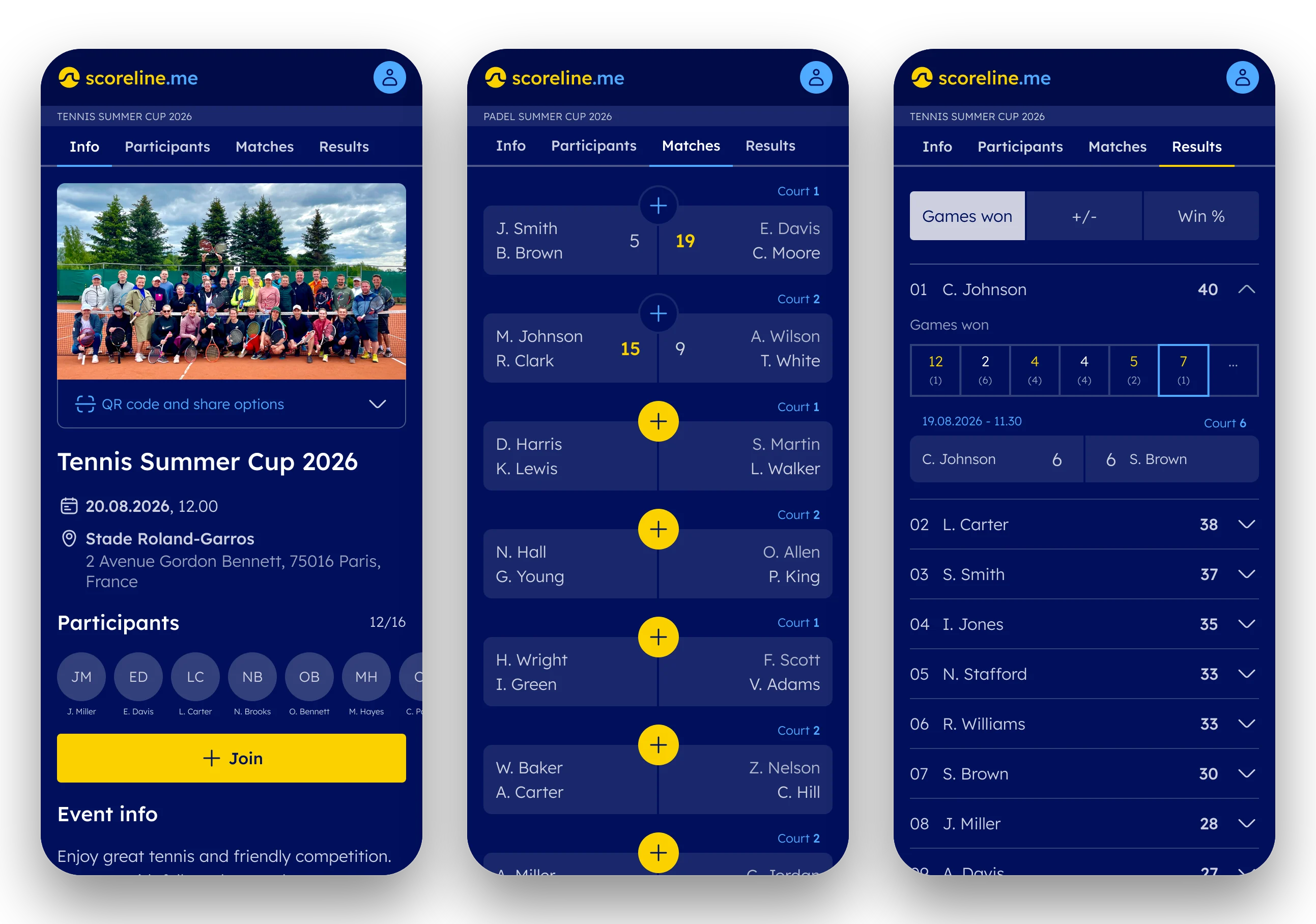
Scoreline — scoring and tournaments for sports events. An organiser creates an event in seconds, shares one link, and everyone follows the draw, live scores and the table from their phone — no app to install. I researched, designed and built it end to end, from organiser interviews to a live product.
Try the test versionThree organisers, one spreadsheet.
Before drawing anything I interviewed three people who run sports events in Estonia: a monthly club tennis series, Telia's corporate padel events and a national tennis league. Their sports and sizes differed, but all three ran their events on Excel and paper.
Club tennis series
Up to 48 players a month. Draws are built in Excel so nobody meets the same opponent too often; scores are written on paper at each court and typed in afterwards — about 30 minutes per event.
Corporate padel events
8–32 players once or twice a quarter. Americano and Mexicano point formulas in Excel take time, and past results and levels are needed to balance teams. Would pay €3–10 per event.
National tennis league
Up to five league events a weekend, 3–4 hours of preparation. Groups and play-offs with awkward numbers of pairs, tie-break rules, and registration and fees for 100+ players.
What I took from it
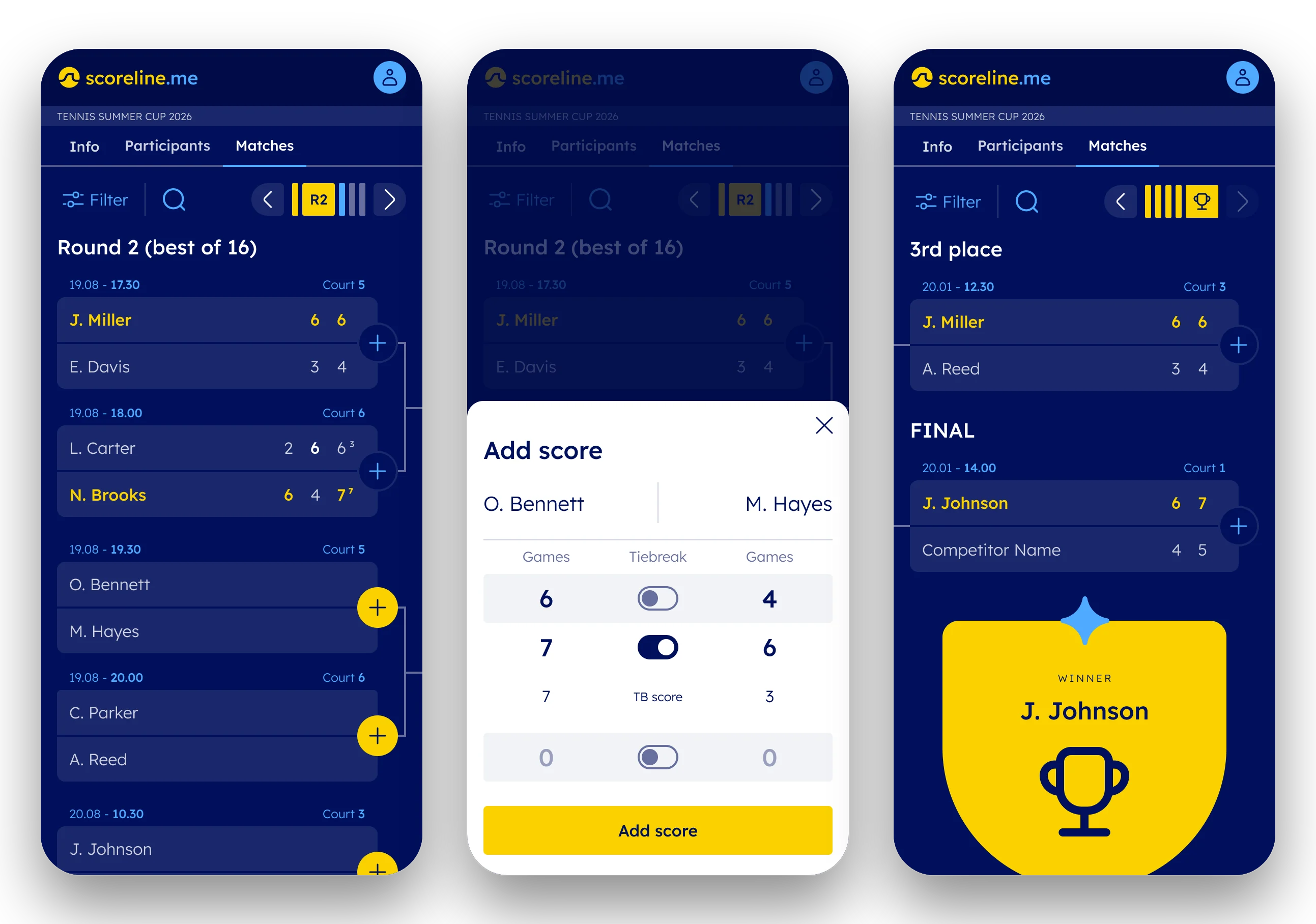
- Scores belong on the court, not on paper: anyone with the event link enters them from a phone.
- The organiser decides what players see. A live table can turn a social evening too competitive, so results can stay hidden until the event ends.
- Formats are the product: Americano, Mexicano, round robin, single elimination with a match for 3rd place, and trainings without a winner.
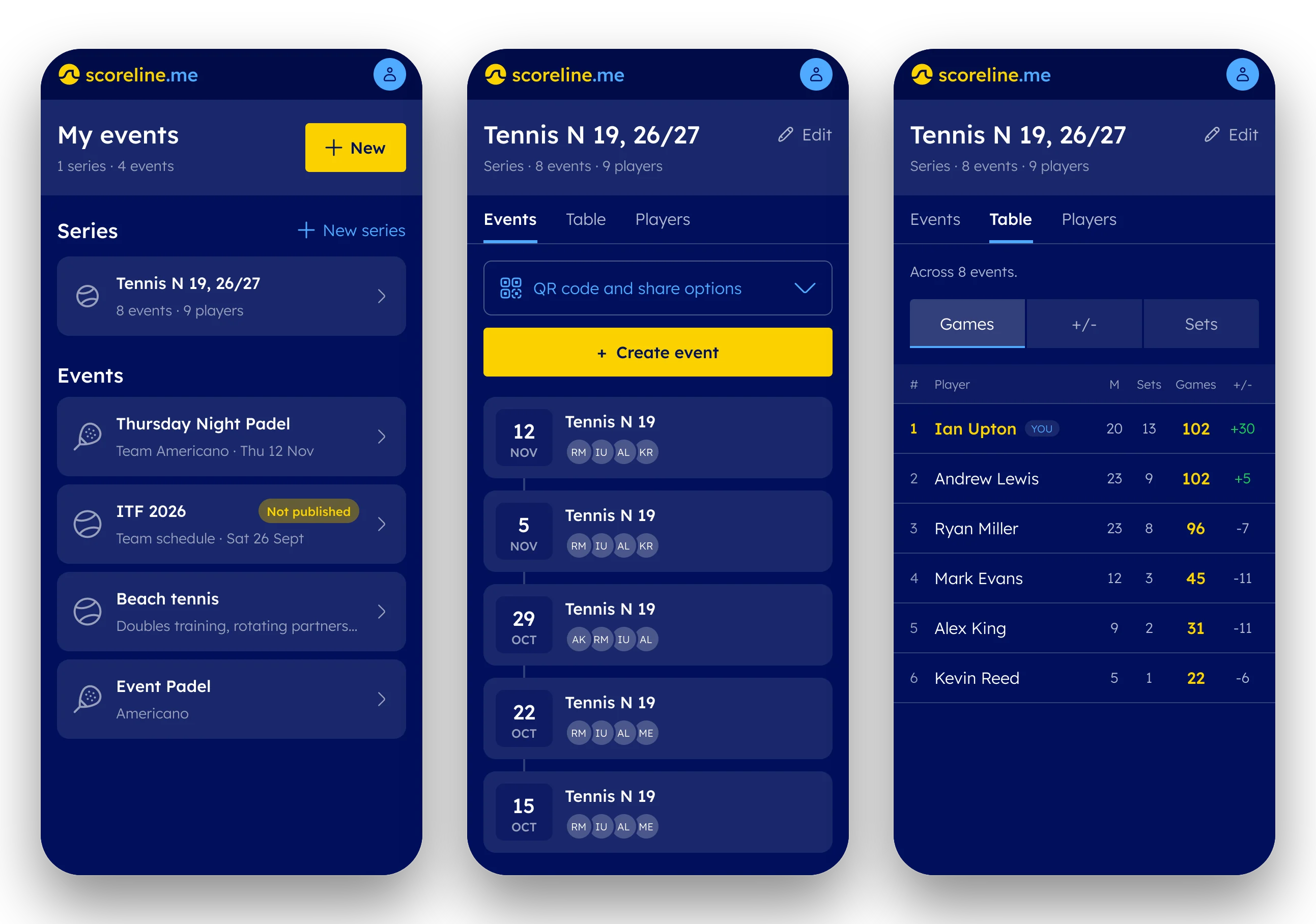
- History matters. Organisers and players want past results, so a series carries a season's roster and one table across every week.
Signal from the courts
- The app has been tested at two Telia tournaments and one popular monthly tennis tournament.
- Feedback was clearly positive: players liked adding results straight from their phones and following the table live.
Built for the courtside phone.
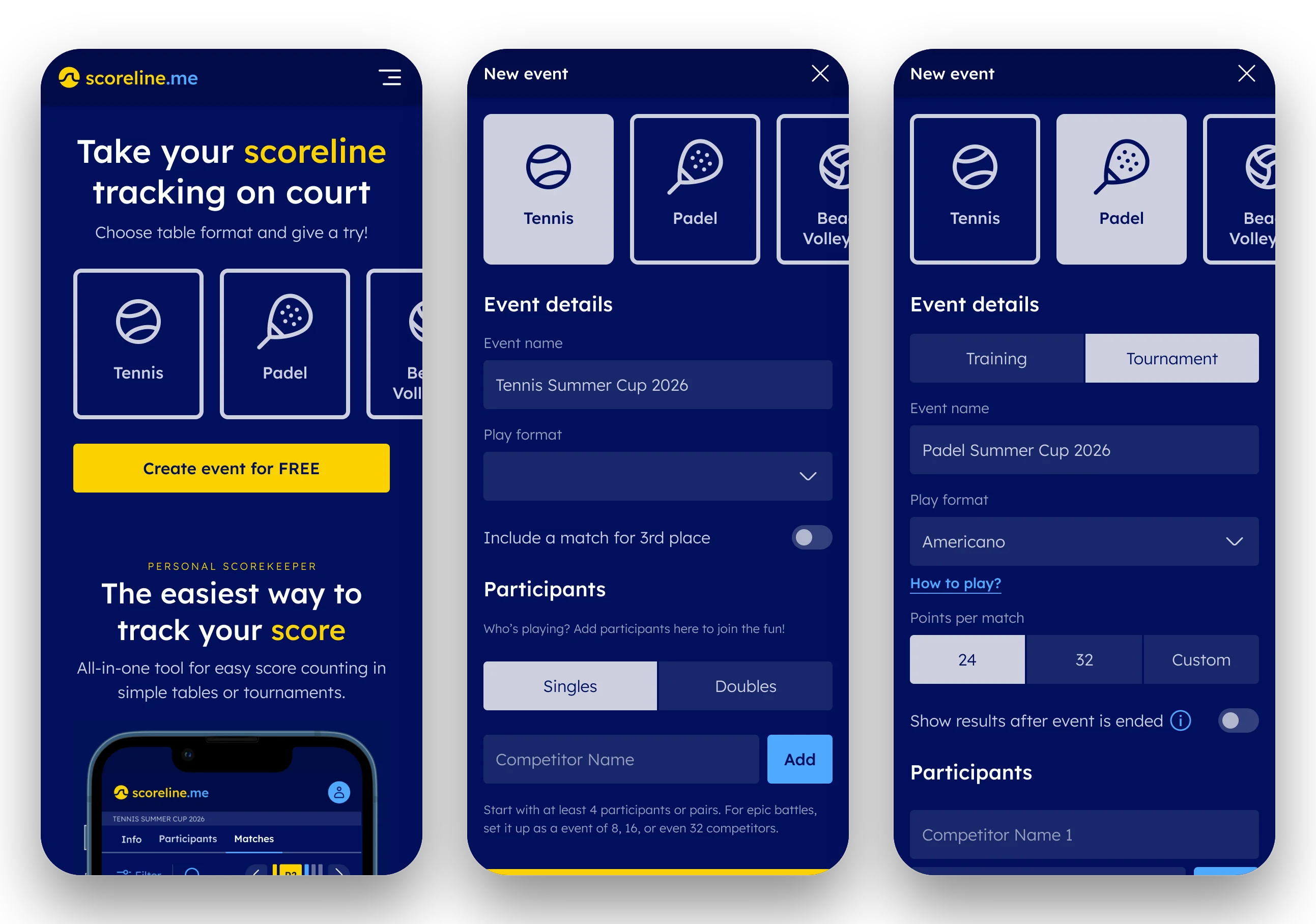
Organisers score between games, often outdoors and on the move. The interface is mobile-first and one-handed: 48 px fields and buttons, one yellow action per screen, and a public link instead of an app to install. Creating an event takes one screen; each sport and format shows only the settings it needs.
From Figma to a live product.
I built Scoreline myself with an AI-assisted workflow — no development team. Designs in Figma go to code through Figma MCP and Claude Code; every change is versioned in GitHub and deployed by Vercel. Supabase holds the data and Resend sends the emails. A written, staged build plan lets each session pick up exactly where the last one stopped.
Workflow and stack
- Figma MCP → Claude Code → GitHub → Vercel.
- React 19 and Vite frontend, FastAPI backend.
- Every push to GitHub becomes a new deployment on Vercel.
Data and email
- Supabase Postgres stores events, players, matches, scores and season series.
- Profile photos live in Supabase Storage and are served through the app's own backend, never from a public link.
- Resend sends the transactional emails: six-digit sign-in codes, welcome, email confirmation and password reset.
- Both are called from the server only, so no keys reach the browser.
AI inside the product
- An organiser photographs a printed league schedule — 40 players, 10 teams, 90 matches — and gets a ready event.
- Claude only transcribes the sheet; code then checks it against the sheet's own repetition, so a misread name is outvoted rather than “tidied up”.
Design system in code
- Semantic colour tokens, type styles and agreed component sizes documented for every session to follow.
- 131 icons generated from the Figma icon set.
- Motion with a purpose — rolling scores, re-sorting tables — that stops when the user prefers reduced motion.
Designed in code, not only in Figma
- Some views were designed straight in the browser and are ahead of Figma: My events with participants' photos or initials, and training series with a season table.
- Figma remains the source for the core flows and the component library.
Where it stands.
Scoreline is live as a test version. The next step is running real events with the organisers from the interviews — the club series, corporate padel and league play — and settling pricing: a fixed licence or a small fee per event, both of which came up in the interviews.